
Home › Black walnut buyers
We buy black walnut trees across Ohio
Walnut is the most valuable hardwood most Ohio landowners own, and the one that is most often sold for far less than it is worth. We will tell you straight what yours is worth — including when the answer is "not much".
Why walnut gets its own page
On most Ohio woodlots the walnut is the smallest part of the timber by volume and the largest part by value. A creek bottom or field edge with a dozen mature walnuts along it can be worth more than the rest of the woods put together — and it is exactly that situation where a landowner is most likely to be lowballed, because the buyer knows what the walnut is worth and the landowner does not.
So we cruise walnut differently. Oak and poplar are tallied for volume. Walnut is looked at tree by tree, because one veneer-grade stem can be worth more than a truckload of sawlogs, and whether a tree makes veneer comes down to inches and defects you have to stand next to it to see.
Where walnut grows well
Deep, rich, well-drained soil: bottoms along creeks, the lower slopes of hollows, old fence rows and field edges where the ground was never plowed. If your place has a stretch like that with big dark-barked trees on it, that is what we want to look at.

The walnut in your yard
Most people who look this up own one walnut tree in a lawn, and they deserve a straight answer rather than a sales call. The picture below is that answer.
A tree that grew up in the open spread out low, because it could. The one log that carries a walnut's value — the clear trunk below the first limb — is short. A tree that grew up in the woods reached for light and put twenty feet of straight, clear trunk under its crown. Add that yard trees very often have a nail, a hook or a strand of fence wire grown into them, which no mill will accept, and that felling a tree beside a house is a tree-service job — and most yard walnuts are worth more as shade. Some are not. The check further down will tell you which you have.

The log

The log
Same species, same age, same soil. The money is in the clear trunk below the first limb, and where a tree grew decides how much of that it has.
What makes a walnut worth money
In order of how much each one moves the number.
We buy walnut from 14 inches; veneer generally from 18 and up. Value climbs steeply with every inch past that.
The butt log is where the money is. A tree that runs clear for sixteen feet before it branches is a different animal from one that forks at eight.
Anything that interrupts clear wood drops a log from veneer to sawlog, and a sawlog with enough defect drops again.
A nail, a staple, a strand of fence wire grown into the trunk. Mills will not take the log, so a walnut with hardware in it is a firewood tree.
A walnut that grew up in the woods reached for light and grew straight and clear. A yard walnut spread out low. Same species, very different log.
One big veneer walnut can justify a visit. One small one usually cannot. A dozen along a creek almost always can.
Why inches matter so much on walnut
Board feet climb with the square of diameter — and on walnut the grade jumps at the same time, so a bigger tree is worth more per foot as well as holding more feet.
Is my walnut worth cutting?
Five questions, one honest answer. Not a price — nobody can give you one without standing next to the tree — but a straight read on whether it is worth a phone call.
Wrap a tape around the trunk about 4½ feet off the ground.
Answer the five questions and we will tell you honestly what you are likely looking at.
Questions people ask about walnut
How much is a black walnut tree worth?
Anywhere from almost nothing to several thousand dollars for a single tree, and there is no honest way to narrow that down without seeing it. A large, straight, clear walnut with a long butt log and no metal in it can be veneer grade, and veneer walnut is the most valuable log that comes out of Ohio. A small, limby, or damaged walnut is worth a fraction of that. Diameter, the length of clear trunk before the first branch, and defect decide it.
Do you buy a single walnut tree?
Sometimes. A single large veneer-grade walnut can justify a trip on its own. A single small one usually cannot, because moving a crew and equipment costs the same whether we take one tree or forty. Call and describe it — how big around at chest height, how far up to the first branch, whether it is in a yard or in the woods — and we will tell you honestly whether it is worth a visit.
Will you buy the walnut tree in my yard?
Usually not, and we would rather say so up front. Yard trees branch low, so the valuable clear butt log is short; they very often have nails, fence wire, hooks or old hardware grown into the trunk, which no mill will accept because it destroys saw blades; and taking a tree down next to a house, a driveway or power lines is a tree service job, not a timber harvest. If your yard walnut is genuinely large and clear, call — but most are worth more as shade than as logs.
How big does a walnut have to be?
We buy walnut from fourteen inches in diameter at chest height and up. For veneer, generally eighteen inches and up with a clear, straight trunk. Walnut rewards patience more than any other Ohio species: a tree that is close but not there yet may be worth considerably more in ten years, and we will say so.
What is veneer-grade walnut?
A log good enough to be sliced into thin sheets rather than sawn into boards. That takes a large diameter, a straight trunk with no sweep, and a long section with no knots, seams, holes, bird peck or metal. Veneer logs are bought by the log rather than by the thousand board feet and they command a large premium, which is why a walnut cruise looks at each tree individually.
Are walnut prices going up or down?
They move, sometimes a lot, and anyone quoting you a firm price per board foot over the phone is guessing. What does not change is that big, clear walnut is always in demand. If you are deciding whether to sell now or wait, the condition of the trees matters more than the market — a healthy walnut can wait; a declining one cannot.
Do you buy walnut logs that are already cut?
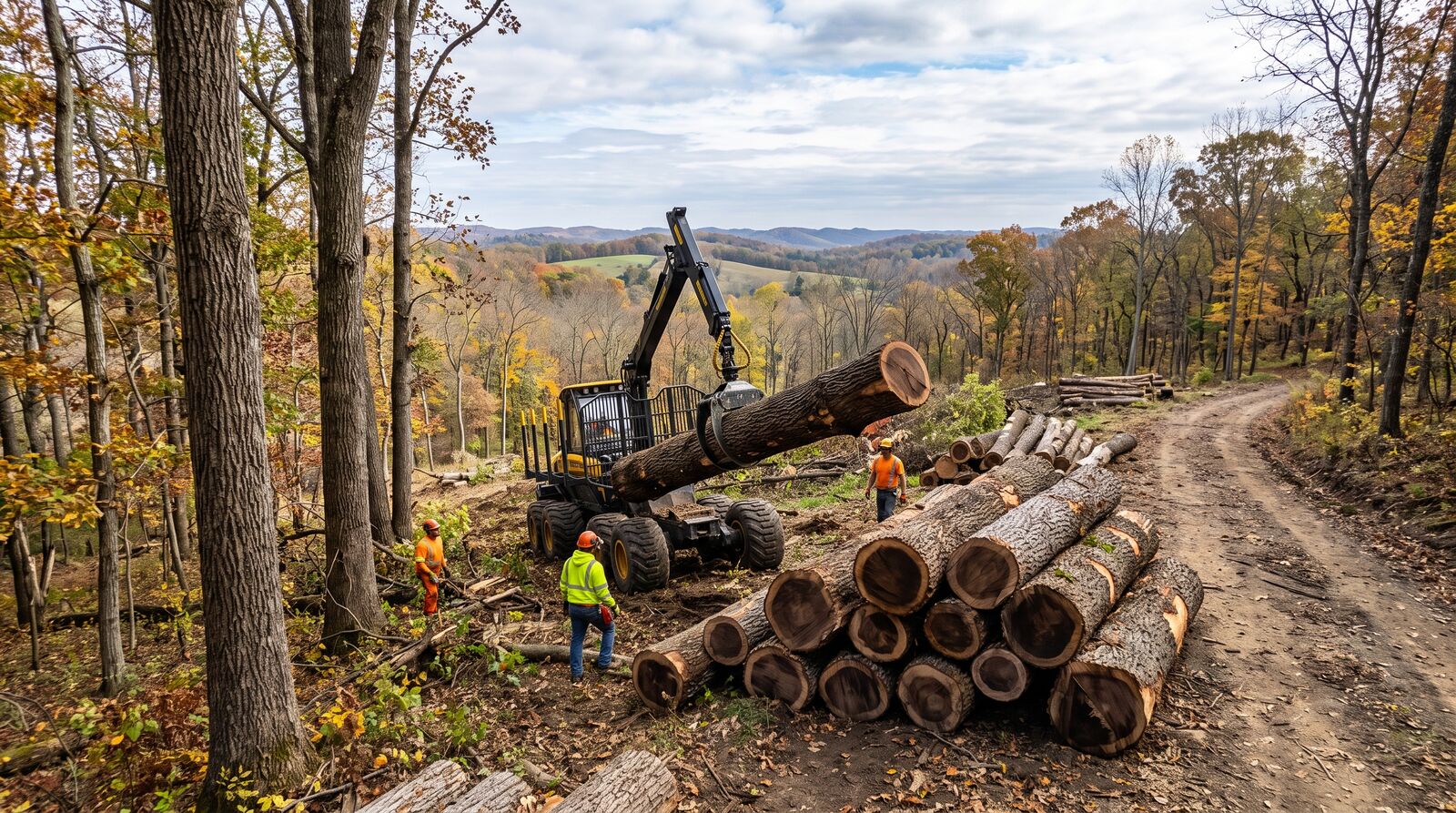
Yes — we buy logs as well as standing timber. If you have walnut already on the ground, the important things are that it was cut recently, that the butt was not left in the dirt, and that the logs were not bucked too short. Call before you cut anything else; log length and where you make the cuts affect what a walnut is worth more than most people expect.
Before you let anyone cut a walnut
- Get the offer in writing, with the trees marked and counted.
- Ask how they arrived at the number. If there is no tally, there is no number.
- Do not let anyone buck the logs until a buyer has looked at them — where the cuts go changes the value.
- Ask what happens to the rest of the property: the lane, the fence, the field edge, the tops.
We will walk your walnut at no cost and tell you what you have. If it is worth waiting on, we will say that too.
Find out what your woods are worth
We will walk your property, tally what is there and tell you straight what it is worth — at no cost, and with no obligation to sell.
Joe or Autty answers the phone. Or send your details and we will call you.